



Wealth Matters Newsletter - October 2025
Market Crossroads, Policy Uncertainty, Fed Challenges, and the AI Disruption
Mark P. Bernier, CFA, Senior Vice President/Wealth Management Officer Jonathan M. Williams, CFA, CFP®, Vice President/Trust Investment Manager Zachary S. Herigan, Trust Investment Analyst
Today’s financial markets seem to be staring down a challenging mix of politics, policy, and technology, blurring the outlook for businesses leaders, policymakers, and investors. With the U.S. government in the midst of a shutdown, the Federal Reserve (the Fed), already struggling with how to respond to conflicting economic signals, will have an ever more difficult role if the current shutdown is not resolved quickly. Add to this the disruptive potential of artificial intelligence (AI) rippling across industries, uncertainty has become the dominant theme.
The Government Shutdown’s Market Impact
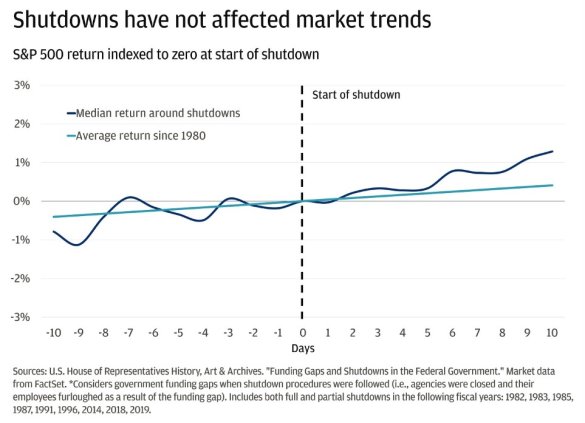
While there’s no such thing as a good government shutdown, historically financial markets have shown resilience in the face of short-term shutdowns (see chart below). However, today’s episode does seem to come with outsized risks. Beyond the obvious disruption to federal services, the shutdown hampers the flow of timely economic data relied upon by policymakers and markets alike. Without reliable readings on jobs, inflation, and growth, both Wall Steet and the Fed are left flying partially blind. In the lack of data to guide the markets, a prolonged shutdown will likely chip away at consumer confidence and spending, constraining economic activity.
Our expectations have been exceeded on all fronts. In a year defined by geopolitical uncertainty and shifting economic dynamics, we have seen broadening strength for U.S. equities to include large value stocks, mid-sized companies, and more recently small capitalization stocks as well. Perhaps the most surprising development that has quietly altered the global investment landscape has been the persistent weakening of the U.S. dollar, leading to outperformance for non-U.S. equity markets, most dramatically, European stocks.
The Fed's Dual Mandate
As the guiding force in shaping U.S. monetary policy, the Fed is tasked with a dual mandate of promoting maximum sustainable employment while maintaining stable prices (a target of 2% inflation over the long run). The Fed’s policy decisions must balance its two assigned objectives. When the data seems to paint different pictures, like we see in the current situation, the balance of risks tilt more strongly to one rather than the other objective.
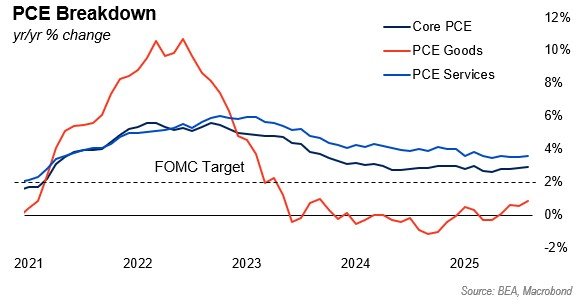
The Core Personal Consumption Expenditures Index Excluding Food & Energy (Core PCE), the Fed’s preferred measure of inflation, has been running hotter than the target rate of 2% since the first quarter of 2021 (see chart below). The most recent reading, August PCE, saw the inflation rate closer to 3% rather than 2% for both core and headline measures. Despite inflation running consistently hotter than target, the Fed cut the federal funds rate by 25 basis points at the September meeting, citing labor market weakening as the primary reason to ease the policy rate. Fed funds futures markets currently predict that the Fed is likely to cut by another 50 basis points (0.50%) by the end of the year, with one 25 basis point cut at the October meeting, followed by another at the December meeting.
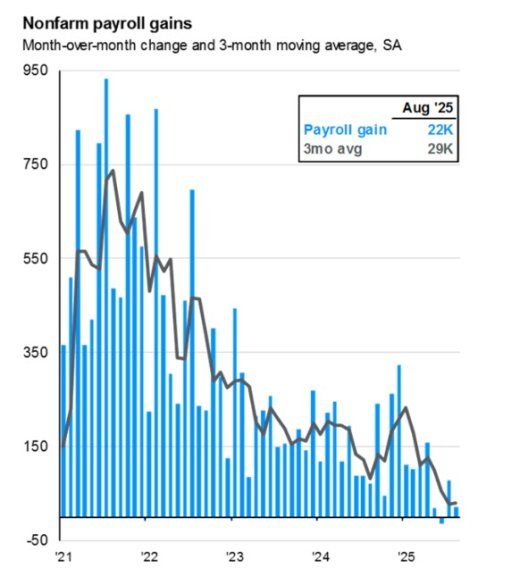
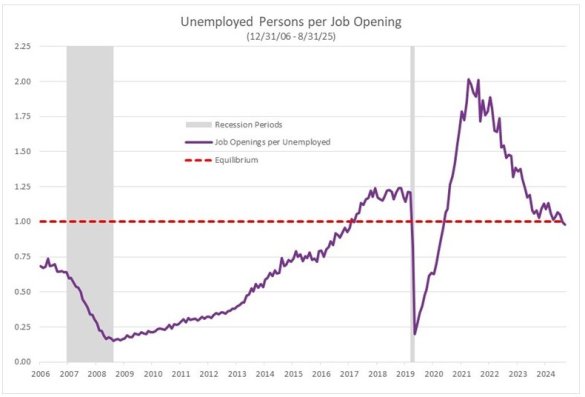
Regarding labor market weakening, numerous data releases appear to indicate that job growth is slowing. The Monthly U.S. Employment report, released by the Bureau of Labor Statistics (BLS), shows significant deceleration in job growth (see left chart below), while the ratio of job openings per unemployed are currently at their lowest levels over the last several years (see right chart below). Weakness in the employment picture suggests cooling future demand, and with consumer spending accounting for about 2/3 of economic activity, the economic outlook may be dimming.
Raising rates further risks pushing the labor market into contraction, while easing prematurely risks reigniting price pressures. This is the essence of the Fed’s challenge, navigating a narrow policy channel with limited visibility amid the data gaps caused by the shutdown.
AI, the Emerging Wild Card
Layered on top of this cyclical uncertainty is a structural disruption: the rapid emergence of artificial intelligence. For markets, AI carries a dual identity. In the short run, it is sparking a surge of tech valuations, capital spending, and productivity expectations. In the longer run, however, AI may alter employment dynamics in ways that complicate the Fed’s dual mandate. Productivity gains could temper inflationary pressures, but labor displacement may create pockets of instability in the jobs market. Some economists believe it’s already occurring, as employers have been slow to add to headcount, either hoping for, or already seeing incremental efficiency gains brought on by integrating AI into current workflows. Whether AI ultimately becomes a stabilizing force or another disruptive variable remains an open question, but markets are already trading on both the promise and the risk.
AI: The Modern Day’s Arms Race
At the risk of borrowing an oft-quoted phrase, history may not repeat, but it often rhymes. As new technologies emerge, massive spending flows to the best capital return opportunities, resulting in a speculative frenzy that often culminates in pain. It appears the same could be occurring today. According to Michael Cembalest of J.P. Morgan Asset Management, a group of 41 companies associated with AI have accounted for 90% of capital spending since the inception of OpenAI’s ChatGPT in late 2022. This figure truly speaks volumes as to the level of conviction business leaders have in this technological revolution. However, as in the past, eventually winners and losers will be declared; for now, massive investments to capitalize on the promise of AI have resulted in extreme valuations in many individual stocks – seeping into the broader market as well.

Navigating the Uncertainty
Investors face a rare trifecta of uncertainty: political dysfunction, policy ambiguity, and technological disruption. The government shutdown adds immediate noise, the Fed’s mandate highlights policy trade-offs, and AI introduces structural unknowns. Together these forces underscore the importance of discipline in portfolio strategy, balancing near-term caution with a long-term eye on durable growth, fueled by disruptive innovation.
As the next chapters of this story unfold, the one certainty is that volatility is unlikely to fade soon. Markets are recalibrating not just to the usual economic cycle, but to a broader reordering of the political, policy, and technological landscape.
Read other issues of our Wealth Matters newsletter.
Invest with us. Invest with experience.
Not FDIC-Insured - May Lose Value - Not a Deposit - Not Bank Guaranteed - Not Insured By Any Federal Government Entity.
Contact Us

CONTACT ONLINE
Complete the Wealth Management Contact Form to get started right away.

Contact a Team Member
We have dedicated staff that can assist you with applying right over the phone!
Call to get started now!

VISIT AN OFFICE
Our friendly, knowledgeable office staff can take your application at an office convenient to you.
Use our office locator to find an office near you.