



Wealth Matters Newsletter - October 2024
A Changing of the Guard
Written by: Mark P. Bernier, CFA, Senior Vice President/Wealth Management Officer
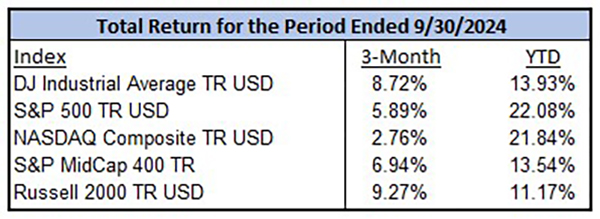
Fall is my favorite time of year. As the leaves change color and nights turn crisp, we are reminded that we live in a world of constant change. Gone are the dog days of summer and all of the inherent summer activities we enjoy, replaced with campfires, a walk in the woods, or watching football. The changes witnessed in capital markets during the third quarter could be characterized similarly, as former areas of market leadership gave way to new groups, central banks changed course, and the U.S. Presidential election landscape experienced its most notable change in decades. Historically, the markets have been weak at the end of the third quarter; September has been the weakest month of the year, on average, for large U.S. stocks for nearly 100 years. The third quarter of 2024 proved to be quite positive for nearly every major asset class, but was not void of volatility.
Leadership within the markets rotated away from large-cap tech stocks and into small-cap and value-oriented stocks early on in the quarter. Primary causes of the rotation were growing concerns about valuations in large-cap tech, the growing possibility of the Fed orchestrating the economic “soft landing”, and the debate performance by President Biden triggering speculation of a more business-friendly policy environment in the next administration. Weakness in large-cap tech stocks and monetary policy actions and comments from the Bank of Japan triggered hasty selling activity in early August, culminating in a 12% single day decline in the Japanese Nikkei 225 (over 27% decline from the index peak in July), and 3% decline for the S&P 500. For several years, investors were able to borrow Yen for nearly 0%, convert to dollars and buy higher yielding investments, including U.S. tech stocks. When the U.S. Federal Reserve indicated it may start cutting interest rates, along with the Bank of Japan hinting at further rate hikes, investors ran for the exits, hurrying to unwind these positions (known as the “carry trade”). Comments from the Bank of Japan after the tumultuous trading session indicating their intention to pause further rate activity spurred a recovery rally that recaptured the losses within a week.
During the currency-triggered spates of selling, there were numerous calls from economists and market pundits for an emergency rate cut from the Fed. It was clear after the July Federal Open Market Committee (FOMC) meeting that a rate cut was likely at the September meeting, but the Fed did not react to calls to take emergency action. Fed Chair Powell’s comments at the Fed’s Jackson Hole Economic Policy Symposium all but confirmed the Committee’s next policy moves. Weakness in employment data, including significant downward revisions to non-farm payrolls figures, and weakening inflation metrics were providing a data-dependent Fed with support to lower interest rates. The FOMC did cut the Fed Funds rate at its September meeting by 50 basis points (0.5%) and the accompanying dot-plot forecast from FOMC members indicated another 50bp of cuts before year-end and another full percentage point of cuts in 2025. The primary risk to the Fed at this point, however, is the possibility that inflation begins to move up. The most recent non-farm payrolls report showed a much larger than expected increase in jobs in September, and the core Consumer Price Index (CPI) measure ticked up to 3.3% year-over-year from 3.2% the prior month. Since the Fed cut interest rates on September 18, the long-end of the U.S. Treasury curve has responded by moving higher; the 10-year U.S. Treasury yield has risen from 3.68% to 4.06% as of this writing. Fixed income markets are likely reflecting (1) continued economic growth and (2) continued deficit spending regardless of who wins the upcoming election.
With the election in mind, consider the infographic from Invesco below plotting average annualized stock performance and the associated real GDP growth rate during each president’s term. What is plain to see is that markets and the economy have performed similarly regardless of what party has control of the Executive branch; in other words, neither party can claim superior market performance.
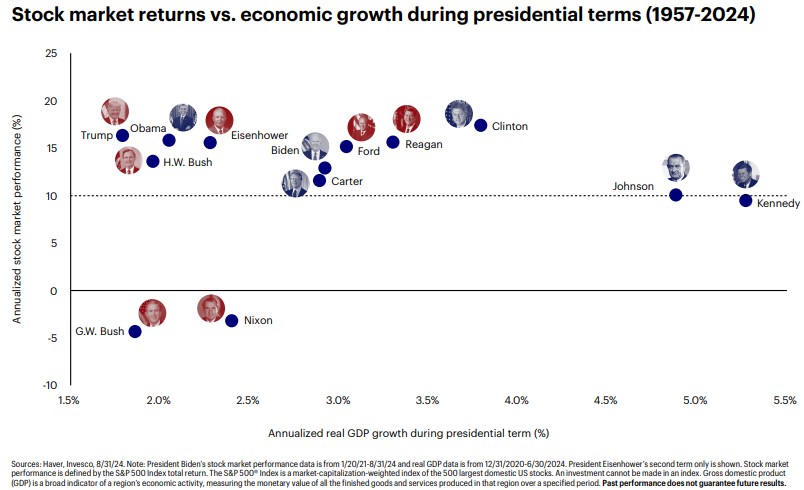
We do expect some volatility before and after the election (a rather common occurrence), but do not consider volatility a “referendum” on the winning candidate. It is likely a reflection of repositioning for potential policy outcomes. We believe that economic growth, earnings growth, and earnings growth potential are far more important to investors’ long-term success than a single election. This election cycle is certainly unique in many ways, but the markets are likely to behave similarly to how they have in the past. The most important takeaway: don’t let a changing of the guard be the driving force behind your investment decisions.
Read other issues of our Wealth Matters newsletter.
Invest with us. Invest with experience.
Not FDIC-Insured - May Lose Value - Not a Deposit - Not Bank Guaranteed - Not Insured By Any Federal Government Entity.
Contact Us

CONTACT ONLINE
Complete the Wealth Management Contact Form to get started right away.

Contact a Team Member
We have dedicated staff that can assist you with applying right over the phone!
Call to get started now!

VISIT AN OFFICE
Our friendly, knowledgeable office staff can take your application at an office convenient to you.
Use our office locator to find an office near you.