



Wealth Matters Newsletter - May 2025
Global markets have been roiled by the Trump administration’s many policy announcements and actions. From DOGE, to trade, to foreign policy, investors have not faced such a barrage of cross currents with global implications in recent memory. As a result, a flight to safety has been has been away from dollar-denominated assets, as both the US dollar and US Treasuries have seen material bouts of weakness in recent weeks.
While markets experienced heightened volatility and downside pressure during the first quarter, the biggest blow came after the President’s announcement of reciprocal tariffs on April 2, 2025. The scale and magnitude of the tariffs was worse than even the most pessimistic expectations, leading to significant declines in global markets for the next several trading sessions. Ultimately it was the selling in the U.S. Treasury markets that caused the most concern on Wall Street and the White House. Investors would have expected the U.S. dollar and Treasuries to rally in response to the risk-off environment after the tariff announcements, but instead it seemed to evolved into a “sell America” event. The U.S. Treasury market is the deepest and most sophisticated debt market, serving as the lifeblood of corporate balance sheets across the globe. Treasury prices dropped sharply due to the volume of selling, which caused yields to rise over a three-day period at a pace not seen since 1982, and shook confidence in the pervasive view of the U.S. dollar as the world’s reserve currency of last resort, which seemingly forced the administration to capitulate.
One week after the initial tariff announcement, the President announced that reciprocal tariffs were being paused for 90 days, to allow countries time to negotiate trade agreements. Order was restored to the Treasury markets, and stocks rocketed higher after the announcement, with many of the hardest hit parts of equity markets experiencing the biggest gains. Yet, it is the “on again, off again” aspect to trade policy that is creating a difficult environment, at best, for investors and hampering the ability of business leaders to make informed decisions.
In essence, President Trump’s tariff plan is an effort to reset global trade relations by using the threat of tariffs as a bargaining tool, although the unclear and inconsistent messaging has caused speculation as to what the President’s end game really is, and how far he is willing to go in order to prevail in the trade negotiations. Economic growth forecasts around the globe have been slashed, and a growing number of economists and strategists are now pointing to a U.S. recession as their base case scenario for 2025, leading to increased likelihood that the Federal Reserve will step in with aggressive rate cuts to re-stimulate economic activity. The challenge is that inflation, which had been moderating from the post-pandemic highs, is still running higher than the Fed’s 2% target, and may accelerate in the short-run if tariffs go into effect on a wide scale, putting the Fed between a rock and a hard place. Clearly this is not the ideal environment within which to cut rates.
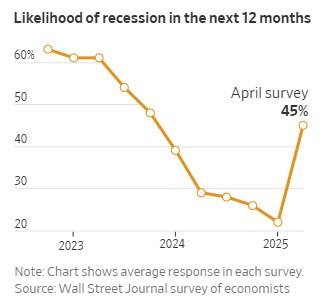
Consumer sentiment cratered during the quarter, along with home builder sentiment, and anecdotal evidence of corporate America reconsidering capex budgets are certainly cause for concern. Lower-income consumers reduced discretionary spending well over a year ago; retail sales reports have been buoyed by middle income and higher income consumers for the better part of two years. However, the wealth affect (housing value and investments) providing those income cohorts the confidence to spend has certainly taken a hit in recent weeks and with all economic data reports, the most recent information is backward-looking. Admittedly, actual consumer spending and consumer sentiment data can diverge, but the relative strength in consumer spending may be evidence of consumers purchasing in advance of tariffs being put into effect. The mosaic we are reading points to an economy that appears to be weakening.
As of this writing, we are in the midst of the first quarter corporate earnings season and the earliest reporters, large banks, have been big winners due to capital markets trading revenues generated from heightened volatility. A number of big tech companies have reported good earnings as well, punctuated by the news that Alphabet’s (Google’s parent company) profits doubled. Contrast that with the fact that a number of other major companies (Delta, Walmart) have pulled earnings guidance, as consumers have already reduced spending, and the uncertainty of tariff implementation/impact is making it difficult for corporate leadership teams to forecast likely outcomes. It is still relatively early for first quarter results, but the typical percentage of companies are beating estimated results. However, since earlier this year, those estimates have been revised down and we’ll likely see full year 2025 earnings estimates for S&P 500 companies cut further in the weeks ahead.
In the near term, investors and corporate leadership teams will be closely tuning into any news coming out of the Trump administration concerning talks with global trading partners, while markets are being pushed and pulled by the optimism, or lack thereof, on the perception of progress in the talks. Markets are resilient over time, but react like a voting machine in the short-run, with the mood of aggregate investors driving the direction of markets, but in the long-run, markets are a weighing machine, and the path of stock markets closely follow the path of corporate earnings. As of this writing, the S&P 500 has bounced 11% off the market trough that was reached on April 8th, while the NASDAQ has gained nearly 14% from the bottom. For markets to stabilize and move forward with any degree of confidence, an actual trade deal with a major globally important nation like Japan, India, or South Korea needs to be inked. We believe that once that transpires, there will be a rush for other countries to ink their own deals with the USA. Until that occurs, we expect continued volatility.
Keeping Volatility in Perspective and Maintaining Discipline
With ongoing uncertainty around tariff policy and continued market volatility, many investors find themselves fighting the urge to respond to short-term swings. With the backdrop of the past two years that resulted in 20%+ annual returns for the S&P 500, it is difficult to watch those gains disappear. Market swings serve as a reminder that volatility is a normal part of investing. On average, about two out of every three years result in positive market returns, which means that on typically about one out of three result in losses. While downturns can be unsettling, they shouldn’t be unexpected. Rather than focusing on short-term market movements, investors are better served by establishing and sticking to a long-term investment plan designed to meet or achieve their specific goals.
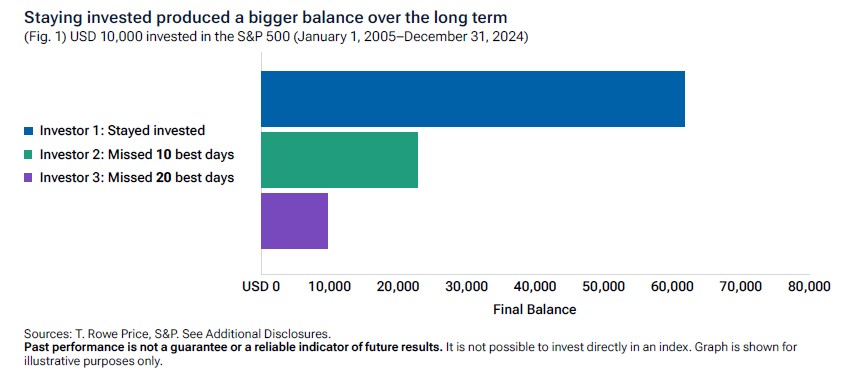
The challenge is that during market sell-offs like we experienced earlier this year, the best days and worst days of market performance historically clump together. Maintaining discipline during market sell-offs and resisting the urge to cash out when volatility spikes, has resulted in greater account balances over time. The chart below, courtesy of T. Rowe Price, demonstrates the value of remaining invested during the prior 20 years as compared to the results of market timing examples in which the best 10 or 20 market days were missed. This is why we encourage clients to stay the course during periods of market stress.
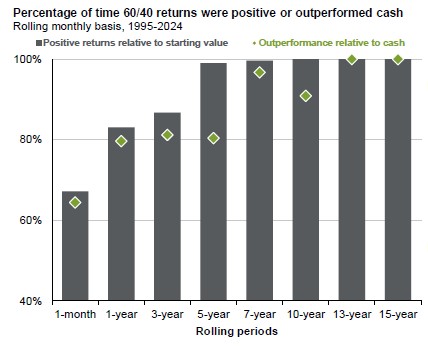
Not only staying invested, but also ensuring that your investments are adequately diversified, helps deliver positive investment results over time. The chart below, courtesy of JP Morgan, depicts the success of maintaining discipline through all types of market environments over time. The concept of having “time in the market”, rather than attempting to “time the market” is a successful long-term approach. A typical balanced allocation with 60% stocks and 40% bonds has outperformed the returns of cash investments with growing probability, and to a greater magnitude, in dollar terms for increasing periods of time. In other words, the longer an investor holds a diversified portfolio of stocks and bonds rather than cash, the greater the amount of outperformance for the balanced portfolio, and the greater likelihood that the investor will outperform cash.
Volatile markets can test the resolve of even the most seasoned investors, but occasional volatility should be the expectation of every investor. In his book, The Psychology of Money, Morgan Housel wrote,” …thinking of market volatility as a fee rather than a fine is an important part of developing the kind of mindset that lets you stick around long enough for investing gains to work in your favor.” In other words, volatility is the price we pay as investors for long-term growth. Markets like those we’ve experienced to date in 2025 can provide the opportunity for personal reflection and reassessment of financial goals. Is your current portfolio the best match for those goals? If the answer is no, or if you’re unsure, talk with your advisor and let logic, not emotion, be the engine behind your decisions. We welcome those conversations and playing an integral part in your long-term financial success.
Read other issues of our Wealth Matters newsletter.
Invest with us. Invest with experience.
Not FDIC-Insured - May Lose Value - Not a Deposit - Not Bank Guaranteed - Not Insured By Any Federal Government Entity.
Contact Us

CONTACT ONLINE
Complete the Wealth Management Contact Form to get started right away.

Contact a Team Member
We have dedicated staff that can assist you with applying right over the phone!
Call to get started now!

VISIT AN OFFICE
Our friendly, knowledgeable office staff can take your application at an office convenient to you.
Use our office locator to find an office near you.