



Wealth Matters Newsletter - July 2024
The Themes of the First Quarter Continued
Written by: Mark P. Bernier, CFA, Senior Vice President/Wealth Management Officer
Monetary policy and large capitalization growth companies continued to be the subject of investor focus during the quarter. Nearly one year since the Federal Reserve’s last interest rate hike, market participants have been forced to continually adjust to the reality of interest rates remaining higher for longer. Inflation readings released during the quarter ticked slightly lower, though not enough for the Fed to begin easing interest rates. Still, most bond markets were able to eke out a positive return during the quarter. Large-cap growth stocks continued to lead stock indexes higher, as the momentum in stocks linked to artificial intelligence technologies proved difficult to break. Corporate earnings releases during the quarter were dominated by technology and communication services names, and exceptional double-digit earnings growth in these sectors contributed to the strongest year-over-year earnings growth of the S&P 500 index since the first quarter of 2022. Will these themes continue during the third quarter or could we see other factors begin to control the narrative this summer?
The Fed and Inflation
As noted above, inflation reports showed small improvement during the quarter. The table below illustrates readings reported during the quarter.
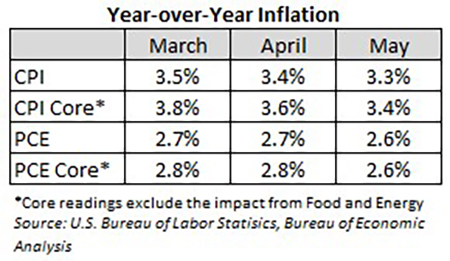
Modest declines in inflation readings released during the quarter have not shown enough progress to alter the Fed’s thinking on monetary policy. Policy makers remain committed to a long-term target of 2.0% annual inflation (PCE) and noted that they were not likely to announce any interest rate cuts without “greater confidence that inflation was moving sustainably toward 2 percent” according to minutes from the June 2024 Federal Open Market Committee (FOMC) meeting. Unfortunately, weakening economic conditions might be the only real solution to the inflation problem and provide the confidence the Fed needs to begin cutting interest rates. For much of the last three years, service-related business activity had been a real bright spot in the U.S. economy. However, service-related business activity contracted for the second time in three months in June; the ISM-Services index fell to 48.8% in June from 53.8% in May (any reading below 50 indicates contraction). The employment report for June, too, showed slowing labor markets, with the unemployment rate ticking up to 4.1% - the highest in the post-pandemic rehiring cycle.
Even if inflation reports in the months ahead show continued progress toward the Fed’s target, the upcoming U.S. presidential election may impact the timing of any Fed decision. Between now and the end of the year, the FOMC has meetings scheduled in July, September, November (just after the election), and December. It is unlikely that conditions will change significantly enough by the July 30-31 FOMC meeting, leaving September, November, and December as potential dates to announce a policy change. Though Fed Funds futures markets are currently pricing in the first rate cut to be announced at the September meeting, we believe September is probably off the table, as the Fed likely does not want to have any policy change viewed as politically motivated.
Markets
Longer-term U.S. treasury yields have been quite volatile this year, as investors and traders have had to recalibrate interest rate and inflation expectations. The benchmark 10-year U.S. Treasury yield finished the quarter 20 basis points (0.2%) higher than where it began the quarter, with a noticeable jump at the very end of June to finish at 4.40%. The increase at the very end of the quarter was being attributed to comments made by former president Donald Trump about his desire to implement additional trade tariffs, should he be re-elected. Softening economic conditions over the course of the next few months would support a decline in U.S. Treasury yields, and any material scaling of geopolitical tensions would certainly trigger a flight to safety and further push yields lower in the short-term. Investment-grade and high yield corporate bond yield spreads could widen, reflecting slower economic growth.
Stock markets ended the quarter predominantly positive, with the NASDAQ Composite leading the way, followed by the S&P 500.

Technology and Communication Services stocks continued to lead market returns during the quarter. S&P 500 returns continue to be driven by a small group of very large companies; the top 10 stocks represented over 35% of the total index value at the end of June. While many of these companies represent some of the best product and service franchises in the world, it begs the question: are the returns of these few companies masking the struggles of the many? If we answer that question using stock returns as the measure of struggle, then the answer is a resounding yes. Consider the other well-known and followed stock indexes in the table above. The Russell 2000, which represents small, domestic companies, generated a paltry 1.73% return through the end of June. Looking closer at the S&P 500 index, and instead of using a market capitalization weighting as the index is currently constructed, we use an equal-weighted construction (every company has the same weighting within the index), the year-to-date return would drop to 4.70%. In other words, the average stock within the S&P 500 is performing much worse than the top 10.

As we head into the back-half of 2024, we expect these conditions in the stock market to continue, so long as the companies leading the way continue to deliver on what are certainly lofty earnings expectations. If the Fed were to make an interest rate cut before year-end, we could see the market rally broaden to include other stocks of all market capitalizations, and perhaps see international stocks begin to lead. As noted earlier, we believe a rate cut is unlikely until after the election. We anticipate elevated market volatility as we move closer to the election, and this cycle certainly may have more to offer than most.
Read other issues of our Wealth Matters newsletter.
Invest with us. Invest with experience.
Not FDIC-Insured - May Lose Value - Not a Deposit - Not Bank Guaranteed - Not Insured By Any Federal Government Entity.
Contact Us

CONTACT ONLINE
Complete the Wealth Management Contact Form to get started right away.

Contact a Team Member
We have dedicated staff that can assist you with applying right over the phone!
Call to get started now!

VISIT AN OFFICE
Our friendly, knowledgeable office staff can take your application at an office convenient to you.
Use our office locator to find an office near you.