



Wealth Matters Newsletter - January 2025
Thoughts for the New Year
Written by: Mark P. Bernier, CFA, Senior Vice President/Wealth Management Officer, Jonathan M. Williams, CFA, CFP®, Vice President/Trust Investment Manager, and Zachary S. Herigan, Trust Investment Specialist
Early January is a time when many of us consider what opportunities may await, what new behaviors might we enact, and what old behaviors we might leave behind. For our team at ACNB Wealth Management, it is a time we dedicate to considering what may be in store for investors in the year ahead. 2025 presents a unique set of challenges and opportunities, as we face uncertainty in the form of important policy shifts that will occur under the Trump administration. Markets are likely to experience bouts of higher volatility this year, but it is important for investors to remain focused on long-term goals. Before considering critical factors for 2025, we recap the final days of 2024 and provide some perspective from market history.
Markets
After the market peaked in the middle of December, the Fed triggered the largest one-day sell-off on a Fed Day since 2001 on December 18th when it announced that 2025 is likely to see fewer rate cuts, notably two rather than the four the markets had come to expect. The magnitude of the reaction in the equity markets put into perspective investors’ hopes of lower rates to boost widely lofty earnings expectations. Stocks limped to the finish of 2024 by posting losses in each of the final four trading sessions, capping a volatile December that saw the Dow record ten consecutive losing days mid-month. Despite the late year swoon, U.S. equity markets still finished up sharply in 2024, with the S&P 500 Index adding 25.02%, on top of its 26.29% return in 2023. The NASDAQ posted 31%+ returns in 2024.

Source: LPL Research, FactSet 12/24/24
For the tenth time since 1926, we start the new year following two consecutive years of 20%+ returns for the S&P 500. In four of the previous nine instances, the third year delivered losses, double-digit returns happened four times, and in one occurrence single digit returns was the result.
“According to consensus data compiled as of December 31, 2024, the average target price for the S&P 500 at the end of 2025 is 6,708.59 points, a potential upside of approximately 14% compared to its 2024 closing price.” (CMC Markets, Luis Francisco Ruiz, Market Analyst). Referring to the chart above, history would suggest a return on the S&P 500 closer to 5% when considering the return history of 3-year bull markets going back to 1949. This warrants the necessity for a degree of caution when the consensus seems so upbeat. With market valuations for U.S. stocks near historic highs according to virtually any metric, (see the following chart) continued market gains will depend on earnings growth, since it’s difficult to imagine valuations can stretch further.
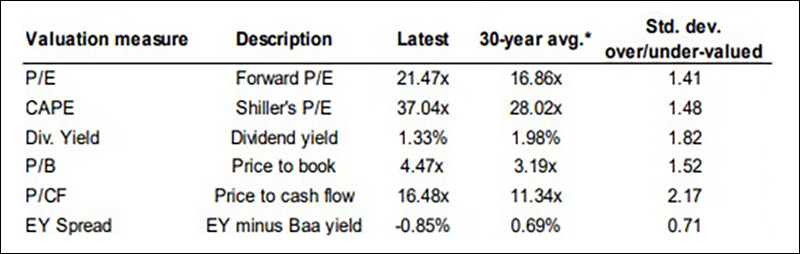
Consensus expectations from Wall Street analysts see S&P 500 firms delivering earnings-per-share growth of 14.8% in 2025, which would support 14% returns for the market without expanding already stretched valuations. Importantly, earnings growth is expected for all 11 sectors of the S&P 500. Of course, even strong earnings growth that fails to meet investor expectations could be greeted with disappointment, especially if it occurs in one or more of the small number of stocks from the Magnificent Seven, that delivered the vast majority of the market’s advance since 2022.
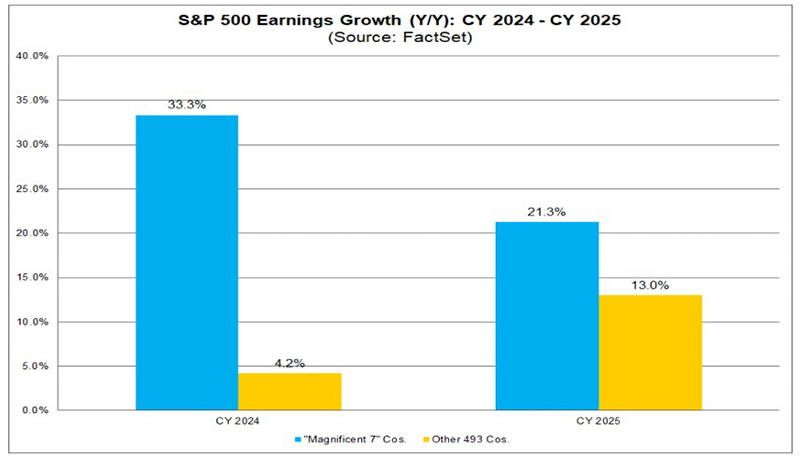
The market capitalization of the Magnificent Seven (Apple, Amazon, Microsoft, Alphabet, Meta Platforms, NVIDIA, and Tesla) accounted for 21.6% of the index in 2022, and ballooned to about 33.4% by the end of 2024. While still forecasted to deliver 21% earnings growth in 2025, the pace of earnings growth for the “Mag 7” looks to slow from the 33% increase of 2024. Meanwhile earnings growth for the “other 493” is expected to more than triple from the 4.2% earnings growth posted in 2024, representing a healthy broadening out of strength (see chart below).
Economy
We expect the economy to continue advancing in 2025, with GDP likely to grow between 2% and 3%. Consensus expectations are for 2.1% (St. Louis Fed, Blue Chip Economic Indicators).
Consumer spending has remained resilient despite inflationary pressures that have disproportionately impacted consumers at the lower and middle thirds of the income spectrum. We closely watch this aspect of the economy because consumer spending accounts for roughly two-thirds of GDP. The resiliency comes from the top income producers who have benefitted from rising home equity values and strong equity market returns. Their ability to maintain spending behaviors distorts the overall picture. Accounting for more than 40% of overall consumer spending, higher income consumers’ household spending has grown at a faster rate than their middle- and lower-income counterparts, despite this group’s wage growth falling behind the pace of inflation.
Meanwhile, consumers in the bottom third of the income continuum are struggling. Despite experiencing the biggest gains in wage growth, relative to the middle and upper tiers, this cohort has struggled to keep pace with higher prices, accounting for multi-year highs in credit card debt and credit card default rates hitting their highest level in 14 years. Despite inflation easing to about 2.5%, the pervasive impact of higher prices remains a big problem for lower income earners who have drawn down reserves and tapped retirement plan savings to meet their basic needs.
Recently, consumers in the middle-third of income earners have been trading down to lower-priced goods in greater numbers than their lower- and higher-earning counterparts. Wage growth for middle-income earners has not kept pace with inflation over the last five years. While they may be exhibiting value-oriented goods consumption, experiential consumption has remained strong.
Business investment should provide some boost to GDP (18% of GDP in 2023), with expectations around 5% corporate spending growth in 2025. However, investors will be watching closely for evidence that spending on AI is translating to earnings growth.
Trump, Fed Policy, and Geopolitics
As we step cautiously into 2025, there is optimism that the incoming administration, and its stated intent to cut corporate and individual taxes, will support continued economic growth. However, this optimism is challenged by the uncertainty generated by President-elect Trump’s hardline stance on tariffs, which many economists believe will result in higher inflation, if not a full-blown trade war that could torpedo economic growth. The top priority of Trump’s second term is expected to be the economy and trade policy; how the administration deals with geopolitical flashpoints, the Russia-Ukraine War, Israel’s ongoing conflicts with Hamas, Hezbollah, and other Iran-proxies, along with growing tensions between China and Taiwan will provide additional complexities that may overhang the markets.
Aggressive tariff policy will likely usher in a trade war with China, and retaliation from more friendly trading partners. Across the board tariffs levied against Chinese goods will have far-reaching and unintended consequences, so it’s likely that a softer approach will emerge and the threat of tariffs rather than tariffs themselves may help achieve desired policy outcomes.
How to play 2025? Be fully invested. We start the year with higher interest rates in fixed income securities. Simply clipping the coupon on intermediate-term investment grade bonds should result in 5% total returns, if rates remain range-bound. Despite lofty valuations in large growth stocks, their success has been driven by prior years’ growth in revenues and earnings. We expect this leadership to continue; however, earnings growth elsewhere supports opportunities in less expensive areas of the market.
Read other issues of our Wealth Matters newsletter.
Invest with us. Invest with experience.
Not FDIC-Insured - May Lose Value - Not a Deposit - Not Bank Guaranteed - Not Insured By Any Federal Government Entity.
Contact Us

CONTACT ONLINE
Complete the Wealth Management Contact Form to get started right away.

Contact a Team Member
We have dedicated staff that can assist you with applying right over the phone!
Call to get started now!

VISIT AN OFFICE
Our friendly, knowledgeable office staff can take your application at an office convenient to you.
Use our office locator to find an office near you.