



Wealth Matters Newsletter - April 2024
Continued Climb
Written by: Mark P. Bernier, CFA, Senior Vice President/Wealth Management Officer
The first quarter of 2024 provided investors with a mixed-bag of returns. Generally, stocks continued their upward climb, while bonds experienced mild declines during the quarter, as investors continue to assess and reassess the likelihood of Federal Reserve interest rate cuts during the year. Inflation readings early in the quarter reminded investors that the inflation problem has not been resolved, and the Fed is determined to keep interest rates elevated until they are confident that inflation is retreating toward its long-term target of 2%. Artificial intelligence remained a prevailing theme amongst stock investors during the quarter, which proved stronger than the impact of a Federal Reserve likely to maintain restrictive monetary policy until the summer. Strong corporate earnings releases in the weeks ahead will be critical for stocks to maintain and build upon the gains experienced so far in 2024.
The table below illustrates returns exhibited by various stock market benchmarks during the first quarter.

Growth-oriented investments continued to outpace value investments during the quarter, across all market capitalizations, as artificial intelligence (AI) themes continued to draw investor appetite. Nvidia, the computer chip company that has been at the center of the AI euphoria, saw its stock return 82.46% in the first quarter alone. Mentions of AI during corporate earnings conference calls also increased over the prior period. Artificial intelligence may very well be the next paradigm shift for the global economy, much like the advent of the world wide web in the previous century, but certainly there will be winners and losers as it pertains to investments in the technology. The current investment environment surrounding AI is somewhat reminiscent of the late-1990’s dot-com era, as illustrated in the graph on the reverse side of this newsletter.
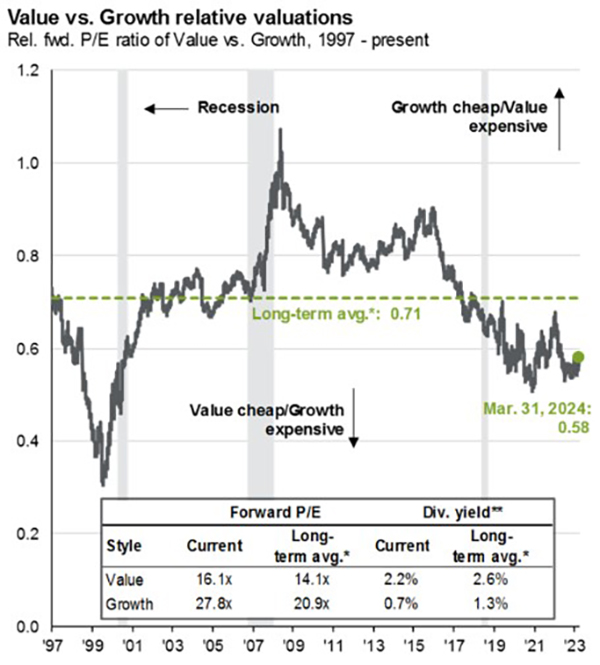
Growth is represented by the Russell 1000 Growth Index and Value is represented by the Russell 1000 Value Index.
*Long-term averages are calculated monthly since December 1997.
** Dividend yield is calculated as the next 12-month consensus dividend divided by most recent price. Returns are calculated by annualizing the average monthly performance during each interest rate range.
Source: FactSet, FTSE Russell, NBER, J.P. Morgan Asset Management.
While current stock valuations are certainly not as stretched as they were during the dot-com bubble, investor sentiment is approaching levels of optimism that were present during that era. The American Association of Individual Investors weekly sentiment survey indicated that only 22.45% of respondents were bearish, or had a negative assessment of the markets, at the end of the quarter. Stocks will need the support of solid corporate earnings and earnings guidance, or risk a sell-off in the near-term. In our opinion, a stock market correction may be warranted, if not welcomed, and would provide the opportunity to reassess stock market leadership. As noted in our newsletter in January, market leadership remains very focused and an expansion of market participation would be perceived as a healthy improvement in the stock market’s dynamics.
Fixed income investors saw some of last year’s gains unwind during the first quarter. Inflation measures released during the quarter supported the notion that the Federal Reserve would not be cutting interest rates as quickly as the market had anticipated at the end of 2023. According to the CME Group’s FedWatch Tool, futures markets anticipate the first rate cut to occur at either the June or July Federal Open Market Committee (FOMC) meeting. FOMC members are clearly concerned with repeating the monetary policy mistakes of the 1970s, which did little to combat inflation and inflation expectations, and certainly, we would prefer not to relive the economic conditions of that time. For much of the first quarter of 2024, the Fed has been trying to communicate its steadfastness in fighting inflation in an effort to better correlate market expectations with its own. As rates have risen slightly since year-end, and expectations for the number and magnitude of rate cuts has fallen, perhaps the Fed’s messaging is beginning to connect with investors.
As we head into the second quarter, corporate earnings and the strength of the consumer are two areas we’ll be watching closely. Consumer spending, in addition to deficit spending, has provided significant support for the economy, but we are concerned that the pace of spending will slow. While wage growth has been a benefit to the consumer, growth in consumer credit balances show that growth in wages has not been enough. While we remain generally optimistic about the economy, we acknowledge that slowing consumer spending will cause our economy to slow. Whether it slows to match the desired “soft landing” outcome for the Fed remains to be seen.
Read other issues of our Wealth Matters newsletter.
Invest with us. Invest with experience.
Not FDIC-Insured - May Lose Value - Not a Deposit - Not Bank Guaranteed - Not Insured By Any Federal Government Entity.
Contact Us

CONTACT ONLINE
Complete the Wealth Management Contact Form to get started right away.

Contact a Team Member
We have dedicated staff that can assist you with applying right over the phone!
Call to get started now!

VISIT AN OFFICE
Our friendly, knowledgeable office staff can take your application at an office convenient to you.
Use our office locator to find an office near you.